
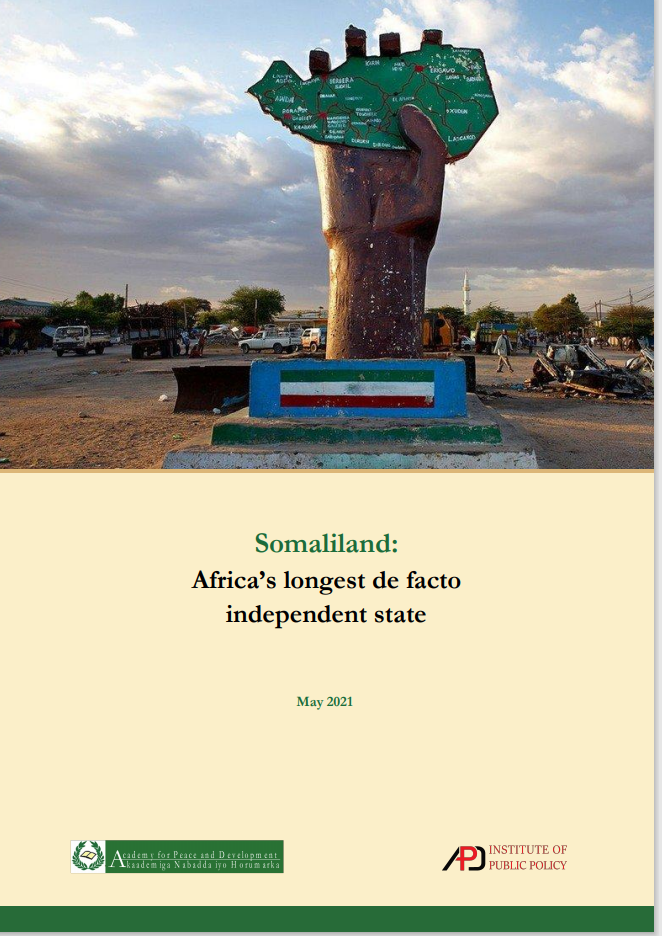
Somaliland: Africa’s longest de facto independent state
Author: Academy for Peace and Development
Abstract
This discussion paper is intended to capture Somaliland’s journey to end violence, reach a durable political settlement through an elite-negotiated process, form a new legitimate and democratic government, and facilitate a free market economy. The paper presents Somaliland's unique approach to peace and state-building- locally-driven, culturally-rooted, reconciliation-focused, and traditionally-engineered processes whereby all key stakeholders were engaged to reach a new political settlement agreed by dominant players. In this regard, the paper argues that the state formation of Somaliland was built on existing traditional informal institutions thus creating a neopatrimonialism political culture. The paper further explains that Somaliland’s success factors for its peace and state-building process are now its major constraints to inclusive economic growth and development. Clientelism and patronage have dominated the political culture forming a small elite circle whose interests threaten the very basic principles of free-market economy.
Bibtex
@workshop{ofPolicy2021b,
title = {Somaliland: Africa’s longest de facto independent state},
author = {Institute of Public Policy and APD},
editor = {APD and Institute of Public Policy},
url = {https://apd-ipp.com/apd-somaliland/wp-content/uploads/2021/05/Somaliland-paper-18-May-anniversary-edited.pdf},
year = {2021},
date = {2021-05-19},
abstract = {This discussion paper is intended to capture Somaliland’s journey to end violence, reach a durable
political settlement through an elite-negotiated process, form a new legitimate and democratic
government, and facilitate a free market economy. The paper presents Somaliland's unique
approach to peace and state-building- locally-driven, culturally-rooted, reconciliation-focused, and
traditionally-engineered processes whereby all key stakeholders were engaged to reach a new
political settlement agreed by dominant players. In this regard, the paper argues that the state
formation of Somaliland was built on existing traditional informal institutions thus creating a
neopatrimonialism political culture. The paper further explains that Somaliland’s success factors
for its peace and state-building process are now its major constraints to inclusive economic growth
and development. Clientelism and patronage have dominated the political culture forming a small
elite circle whose interests threaten the very basic principles of free-market economy.},
keywords = {},
pubstate = {published},
tppubtype = {workshop}
}